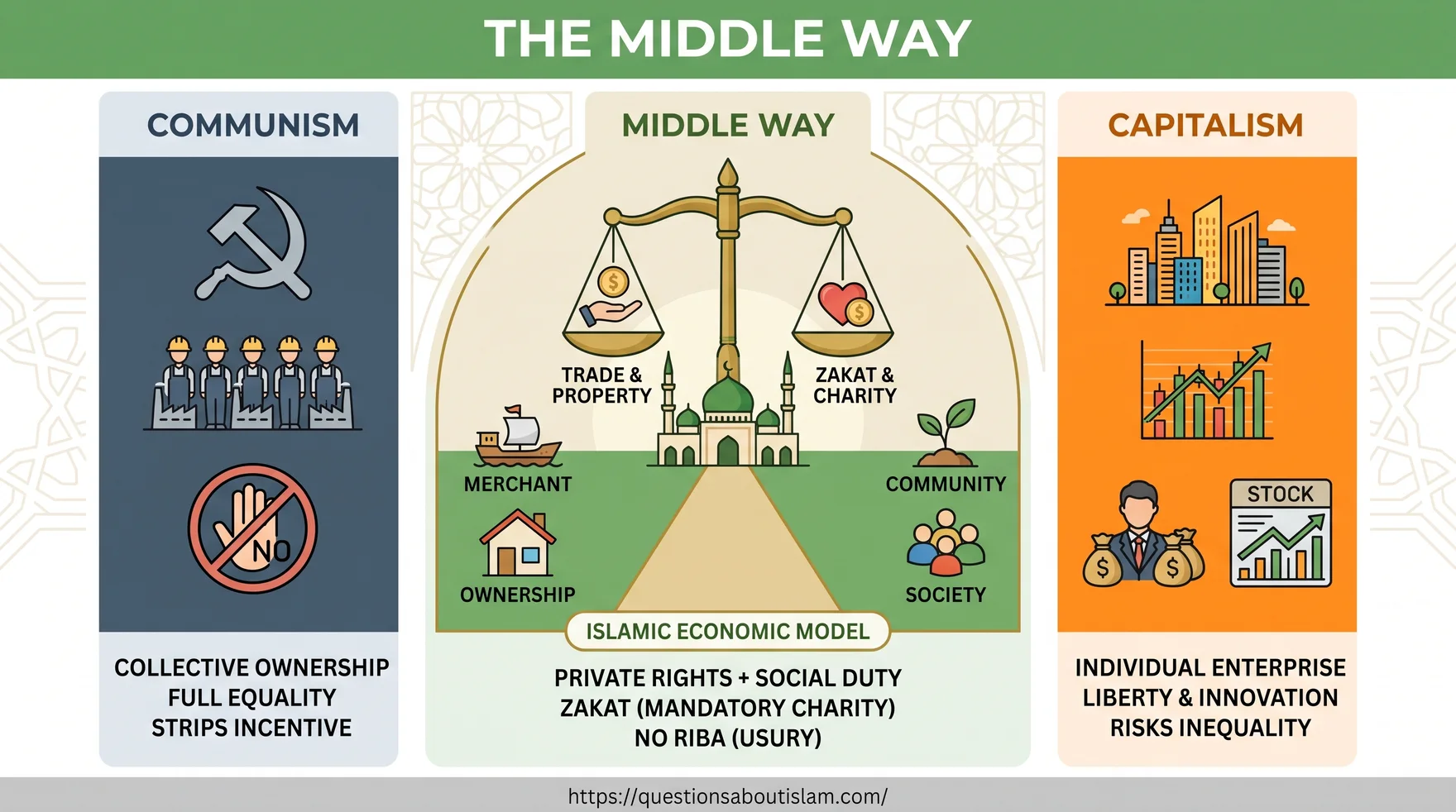
Between Communism and Capitalism: Islam as the Middle Way
For decades, modern political and economic discourse has been dominated by a single, recurring debate: should the state control wealth to ensure equality, or should individual market forces reign supreme to foster liberty and economic growth?
This debate framed the ideological dispute between Communism and Capitalism. Yet, as history has shown, both systems result in profound ethical and economic voids.
Communism aims for complete social equality by abolishing private property. In doing so, it strips away fundamental human incentives to work, innovate, and build personal security, often replacing individual freedoms with state-driven authoritarianism.
Capitalism, on the other hand, safeguards individual freedom and private property rights. However, it lacks any moral constraints and therefore it frequently breeds extreme inequality. Human labor becomes a commodity that is bought and sold in accordance with market forces, concentrating power in the hands of the wealthy and leaving the vulnerable and impoverished to be taken advantage of. While theoretically all individuals have the same freedoms under capitalism, the reality is that the ability to participate in the free market and generate wealth is not the same for a poor person as it is for a billionaire.
Islam offers a distinct alternative: A socio-economic framework that avoids the extremes of both systems. Islam intentionally promotes the middle way in all matters, recognizing that even virtues can become harmful when taken to the extreme. Prophet Mohammad (pbuh) warned on multiple occasions that religious practice itself becomes a negative trait when taken to the extreme.
“O people, beware of extremism in religious matters, for those who came before you were destroyed because of extremism in religious matters.” (Sunan Ibn Majah, Hadith 3029)
This middle way offered by Islam represents a balanced economic model. It protects individual freedoms and property rights while embedding both compulsory and optional social responsibility directly into the fabric of faith.
Protecting Individual Enterprise and Private Property
Unlike Communism, Islam recognizes the human desire to own property, earn a living, and secure wealth as a natural aspect of our human motivations and desires.
Private ownership is strongly protected, while hard work, trade, and earning wealth is encouraged.
"Allah has permitted trade and forbidden interest." (Surah Al-Baqarah 2:275)
"And when the prayer has been concluded, disperse within the land and seek from the bounty of Allah..." (Surah Al-Jumu'ah 62:10)
Prophet Mohammad (pbuh) also emphasized hard work and productivity:
"No one has ever eaten better food than that which he has eaten from the work of his own hands." (Sahih Al-Bukhari, Hadith 2072).
Islamic history reflects this spirit. Prophet Mohammad (pbuh) himself was a successful merchant prior to his prophethood. Many of his prominent companions, most notably Uthman ibn Affan and Abdur-Rahman ibn Auf, were wealthy entrepreneurs. Their wealth was praised because it was earned through ethical trade and utilized to uplift the community.
Islam recognizes the right of individuals to invest, trade, and build wealth freely without fear of arbitrary state expropriation.
Curbing Greed and Protecting Society
While Islam protects market mechanisms and free enterprise, it firmly rejects the concentration of wealth in the hands of a few. Islam teaches us that wealth must circulate through society to maintain social equilibrium.
"So that it will not be a perpetual distribution among the rich among you." (Surah Al-Hashr 59:7).
Islam teaches clear moral and legal boundaries that act to prevent economic exploitation, as well as preventing the unethical pursuit of profits from damaging society through monetization of harmful habits, addictions, and exploitation of human desires.
The Pillar of Zakat (Mandatory Charity)
Capitalism is a purely economic framework that totally ignores charitable giving. It has no moral teachings or frameworks to combat inequality. Such matters are left to the individual and their own moral compass. However, the human desire to accumulate wealth always overwhelms their own moral compass. Greed inevitably results in the concentration of wealth and power. While some individuals in every society will no doubt offer voluntary charity and promote initiatives to help those who are less fortunate, the reality is that these are a minority and are not sufficient.
In Islam, Zakat is a central part of the faith and is considered to be the third of the five pillars of Islam. The Zakat is a mandatory annual giving of 2.5% on qualifying wealth held for at least one year. Zakat acts as a structured mechanism to ensure that the poor and vulnerable receive a portion of the surplus wealth of society.
Capitalism argues that it is up to each individual to work hard and participate in the free market in order to build wealth. But that ignores that not everyone has the same opportunities in life. We are all born into different families and communities, and some of us are privileged with more access to money, education, healthy food, and positive lifestyles that allow us to excel in life. Others are not as fortunate and life is an uphill struggle for them. Also, people are born with different abilities physically and mentally, and some of us face illness and health problems. A capitalist system does not accommodate this and treats everyone the same. This often results in societies and communities with vastly different living standards, often in neighbourhoods that exist side by side. Education, health, and economic participation can be vastly different amongst neighbourhoods in the same city. Gated communities are built to keep undesirable people out of sight and out of mind. All of these issues are symptoms of an unhealthy and unethical society, and the burdens of this inequality eventually result in conflict, strife, and dysfunction.
Communism attempts to address the inequality by preventing private ownership and affording everyone the same lifestyle. But this strips the incentives to work which destroys economic productivity and makes everyone more poor. While the intention is to split economic outcomes equally amongst everyone, the unintended consequence is that economic outcomes are diminished, slowly impoverishing everyone and destroying societies.
Islam addresses these issues through Zakat to prevent these dysfunctions. All members of society, regardless of wealth, race, or status are treated with dignity and afforded the opportunity to live a dignified life. On the other hand, private property ownership and free enterprise are allowed and encouraged to ensure that economic activity is robust and continues to grow. This results in building wealth for the entire society, and Zakat distributes some of that wealth to those who are not able to benefit from the free market for whatever reason.
Optional Charity (Sadaqah)
Beyond the mandatory Zakat, Islam strongly encourages voluntary giving, known as Sadaqah. While Zakat establishes a basic economic baseline for the needy, optional charity empowers individuals to go beyond minimum legal requirements and cultivate genuine empathy for others. The Quran repeatedly urges believers to spend out from their wealth, framing acts of voluntary generosity not as a financial loss, but as an investment that yields immense spiritual rewards:
“The example of those who spend their wealth in the way of Allah is like a seed of grain which grows seven ears; in each ear is a hundred grains. And Allah multiplies His reward for whom He wills.” (Surah Al-Baqarah 2:261).
This voluntary spirit extends beyond mere financial donations. Every noble deed that benefits another human being is recognized as an act of charity. Prophet Mohammad (pbuh) taught a broad definition of giving that encompasses daily social interactions, emphasizing that even the smallest acts of kindness are considered charity.
"Your smile for your brother is a charity, your enjoining the right and forbidding the wrong is a charity, your guiding a man who has lost his way is a charity, your helping a man with poor eyesight is a charity, your removing a stone, a thorn, or a bone from the path is a charity, and your pouring what is left from your bucket into the bucket of your brother is a charity." (Jami at-Tirmidhi, Hadith 1956).
By combining voluntary wealth distribution with daily acts of goodwill, Islam ensures that community welfare is sustained not merely through legislative mandates, but through a deeply ingrained culture of personal benevolence.
Prohibition of Riba (Usury and Interest)
Capitalism relies heavily on interest-bearing debt, which can trap individuals and small businesses in cycles of debt while guaranteeing returns for wealthy owners of capital with minimal risk.
Islam strictly prohibits Riba (usury and interest). Instead, it encourages Qard Hasan (interest-free loans) as a form of charity to help the less fortunate, rather than taking advantage of their need for financial support to manage their lives.
On the business side, Islam encourages profit-and-loss sharing models (such as Mudarabah and Musharakah) rather than loans that carry interest. This ensures that risk and reward are shared equitably between lenders and entrepreneurs.
Ethically Banned Industries
Islam prohibits commercial activities that cause systemic harm to individuals, societies, or to public health. For example, gambling, predatory lending, alcohol and drugs, and the sex industry are not viewed as legitimate business opportunities. While entrepreneurs can generate significant profits working in these industries, the societal harm is too great. Free enterprise is allowed as long as it does not cause harm or take away the rights of others.
Historical Examples of the Islamic Middle Path
This balanced economic framework was actively demonstrated throughout Islamic history.
This was illustrated when Prophet Mohammad (pbuh) and his early companions migrated from Makkah to Al-Madinah. Fresh water was scarce, and it was difficult for most people to afford to purchase enough water for themselves and their families. This sudden need for water by the new arrivals in Al-Madinah translated into high prices, as dictated by the market forces of supply and demand.
Prophet Mohammad (pbuh) encouraged his companions to purchase a local well, known as the well of Rumah, in order to dedicate it for public use. One of the companions who was a wealthy trader, Uthman ibn Affan, bought the well with his own money and dedicated it as a public endowment, making the water freely available to the community and relieving this major challenge. This example illustrates the careful balance between encouraging private enterprise and promoting a healthy society.
Another example of the economic framework taught by Islam was illustrated during the Caliphate of Umar ibn Al-Khattab, who was the third leader of the early Muslim community, after Prophet Mohammad (pbuh) and Abu Bakr. Under his leadership, the Muslim state instituted a formal treasury system, known in Arabic as “Bayt al-Mal” which provided guaranteed social stipends to infants, the elderly, widows, and the poor, regardless of their faith. This early social safety net was sustained by Zakat and public revenues. The result was a healthy and well balanced society living in justice and safety.
Islam does not view wealth creation and social compassion as opposing forces. Instead, it offers a framework where individual freedom is balanced by social duty. By validating the drive for personal achievement while protecting community welfare, Islam presents a timeless middle path for humanity to flourish.